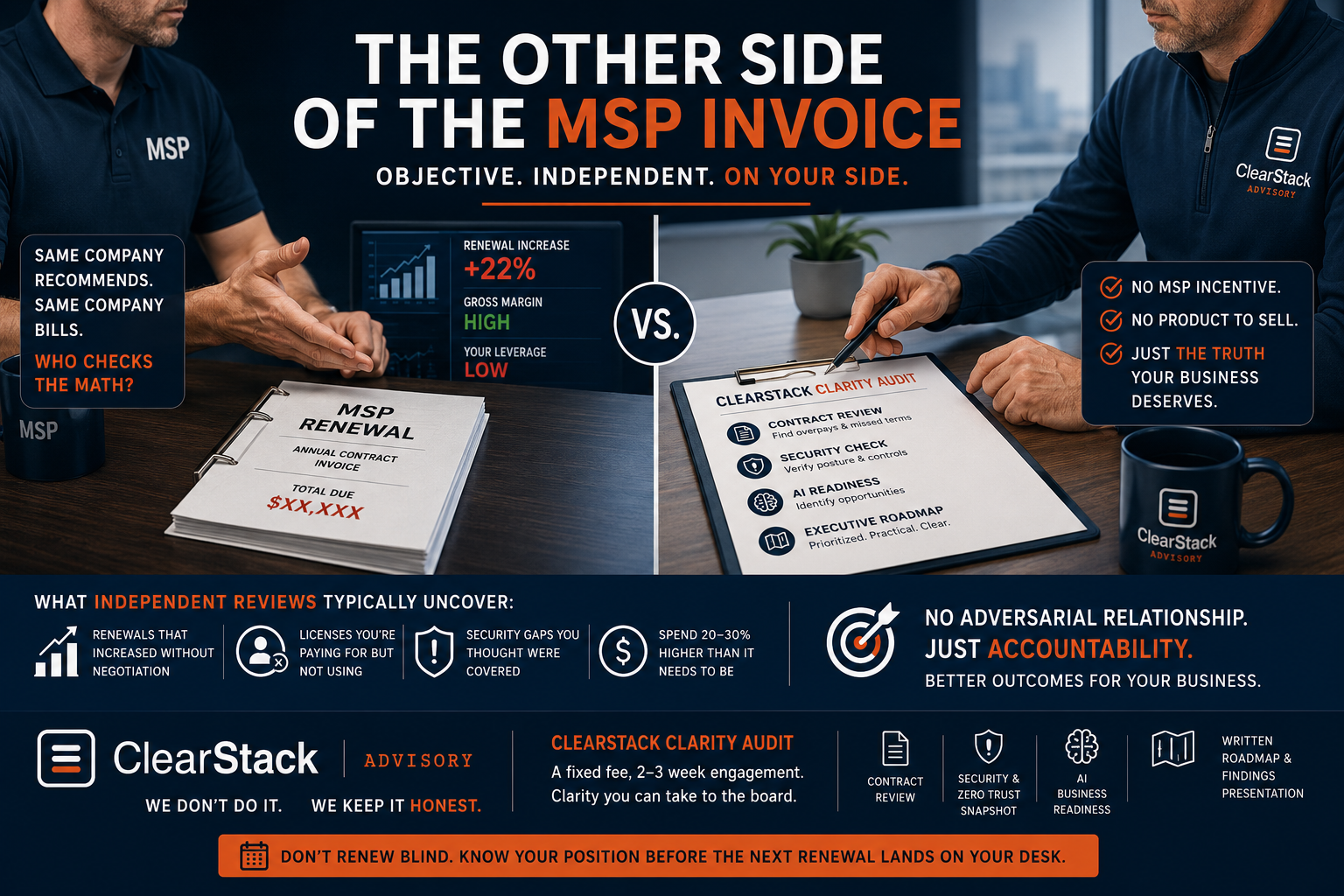
Your MSP recommends the work and bills for it. Here’s why that structure costs mid-market companies more than they realize, and what a healthier model looks like.
Every month, your MSP sends you an invoice. It lists the tickets they handled, the licenses they provisioned, and the hours they spent keeping your systems running. You pay it because the alternative—unmanaged IT—sounds worse. But few business owners stop to examine the other side of that invoice: the business model that determines what your MSP recommends, how they price it, and whose interests come first.
The managed services model is built on a fundamental conflict of interest. Your MSP makes money when you have problems to fix, licenses to sell, and projects to bill. They lose money when your environment is so stable and well-architected that it barely needs them. This is not an accusation of dishonesty. It is a structural observation, and understanding it changes how you should manage the relationship.
The Conflict Nobody Talks About
In a healthy advisory relationship, your advisor’s incentives align with yours. Your CPA wants you to pay less tax legally. Your attorney wants you to avoid liability. But your MSP’s revenue is tied to the complexity and instability of your environment, not to its simplicity and resilience.
This manifests in specific, observable ways:
- License recommendations that favor margin over fit. MSPs earn margin on the licenses they resell. A license that costs you $20 per seat per month and earns your MSP a 15% margin is recommended more enthusiastically than a $12 alternative that fits your needs better but earns them less.
- Project work that expands scope instead of constraining it. When your MSP both recommends and executes projects, there is no independent voice asking whether the project is necessary, whether the scope is right-sized, or whether the timeline is reasonable.
- Reactive service that never quite prevents the next outage. MSPs are paid to respond to problems. There is limited financial incentive to invest in the architectural work that would eliminate entire categories of problems, because each eliminated problem is eliminated revenue.
None of this requires bad faith. It is simply the logic of the business model. And it is exactly why you need an independent voice on your side of the table.
What the Invoice Doesn’t Show
The invoice shows what your MSP did. It does not show what they chose not to do, what they recommended that served their margin more than your interest, or what strategic work went undone because it was not billable.
Consider the strategic questions that no MSP invoice will ever answer: Is our technology spending aligned with our business goals? Are we over-licensed? Is our cybersecurity posture actually adequate, or just adequate enough to keep the contract? Should we be investing in AI, and if so, where? These are CIO-level questions, and they cannot be answered by the vendor that profits from the status quo.
The Fractional CIO as Counterbalance
A fractional CIO sits on your side of the table. They do not resell licenses. They do not bill by the ticket. Their only incentive is the health of your technology environment and its alignment with your business goals.
With a fractional CIO in place, the MSP relationship changes fundamentally:
- Recommendations get a second opinion. Every MSP proposal is evaluated by someone who understands the technology and has no financial stake in the outcome.
- Contracts get negotiated properly. Renewal terms, SLAs, and pricing are reviewed by someone who has seen dozens of MSP agreements and knows what good looks like.
- Strategy gets separated from service. The fractional CIO owns the technology roadmap. The MSP executes against it. This separation of strategy and delivery is how every well-run IT organization works.
What to Do This Quarter
If you have an MSP and no independent IT leadership, you are making technology decisions with input from only one side of the table. Here is where to start:
- Audit your last 12 months of MSP invoices. Categorize every charge: reactive support, licenses, projects. Look for the ratio. If reactive support dominates, your environment is being managed, not led.
- Ask your MSP for their technology roadmap for your business. If they cannot produce one, or if the roadmap is a list of their products, you have your answer about whose strategy you are executing.
- Get an independent assessment. A Clarity Audit from ClearStack evaluates your backups, security, vendors, and AI readiness with no products to sell and no services to upsell. It is the fastest way to see the other side of the invoice.
The Bottom Line
Your MSP is not your adversary. But they are not your CIO either. The sooner you put independent leadership between your business goals and your vendor’s revenue goals, the sooner your technology spending starts serving you.
Not sure where your IT really stands? Start with a Clarity Audit: a focused assessment of your backups, security, vendors, and AI readiness. It’s the first step in every engagement I take on.
About the author: Chris McGlasson is a fractional CIO and the founder of ClearStack Advisory, where he helps mid-market companies build AI governance, IT strategy, and technology roadmaps without the overhead of a full-time CIO. He previously built and sold LANPRO Systems, an IT services firm serving 350+ enterprise clients.