Navigating the Enterprise AI Frontier: Why Your Microsoft AI Deployment Needs a Fractional CAIO
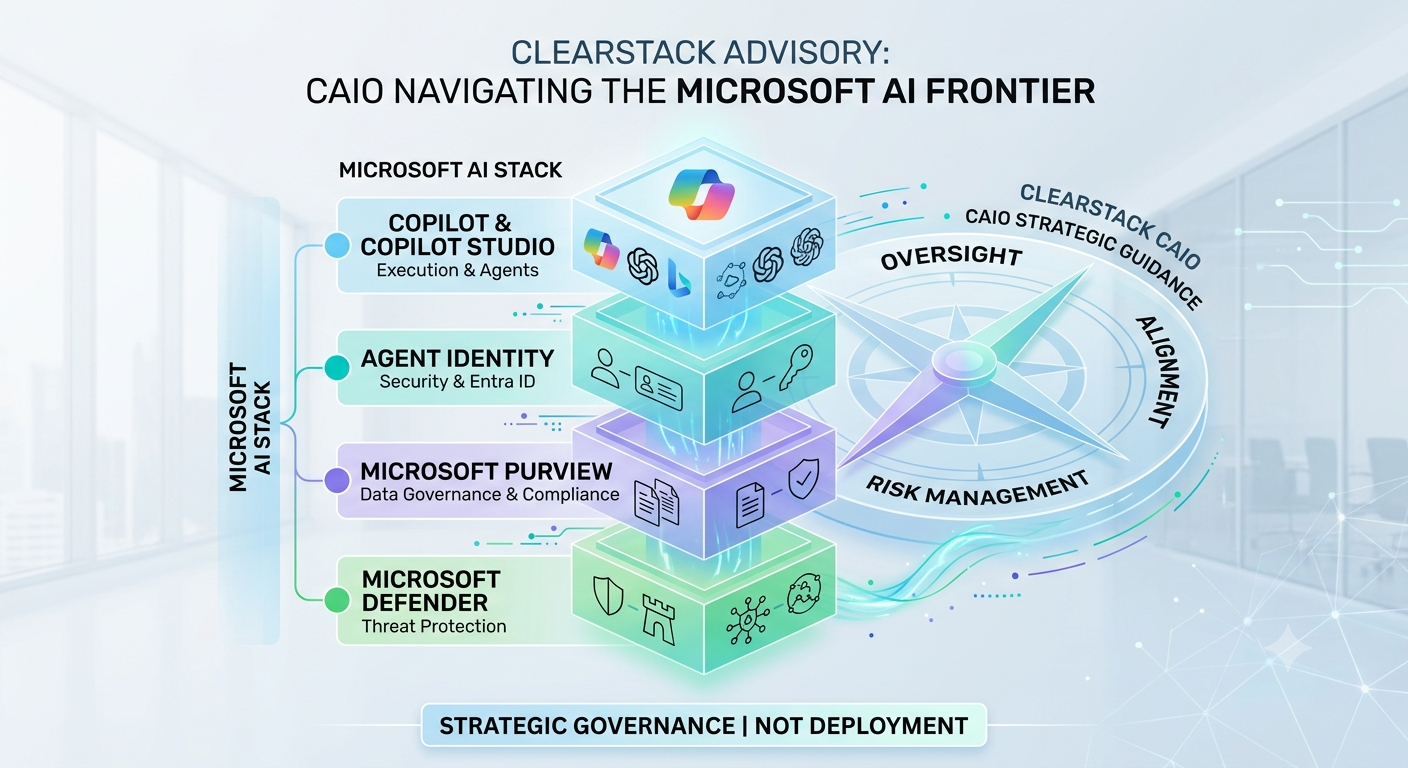
As enterprises rush to deploy autonomous AI agents and intelligent workflows, Microsoft has built one of the most comprehensive ecosystems on the market. However, deploying a secure, compliant enterprise AI strategy requires balancing three massive pillars: Execution (Copilot & Copilot Studio), Data Governance (Purview), and Threat Security (Defender).
For many mid-market and enterprise organizations, coordinating these moving parts is a massive challenge. That’s where a ClearStack Fractional CAIO (Chief AI Officer) comes in. We don’t do the heavy lifting of writing code or configuring infrastructure; instead, we act as your strategic “main set of eyes,” ensuring every critical capability, identification risk, and security loophole is accounted for before and during rollout.
Here is a look at the Microsoft AI stack through a CAIO lens, and the specific questions we help your leadership team answer.
1. Copilot Studio: Managing the Multi-Model Ecosystem
Microsoft has evolved Copilot from a single-model chatbot into an orchestra of autonomous agents. Through Copilot Studio, your teams can now orchestrate workflows utilizing a diverse ecosystem of models, from OpenAI and Anthropic to Microsoft’s specialized MAI reasoning and coding families.
The CAIO Lens: “Just because a team can build an agent doesn’t mean they’ve optimized it for cost or capability.”
We guide the decision-making process by asking:
- Orchestration ROI: Are your developers routing basic tasks to expensive reasoning models when a lighter, open-source model would do the job for a fraction of the cost?
- Agentic Scope: Have we clearly defined the boundaries of what these background agents are allowed to execute via API connectors?
2. Agent Identity & Security: Closing the “Maker” Loophole
Because modern AI agents can actively update CRMs, fetch data, and send emails, they require strict identity boundaries. Microsoft addresses this through Agent 365 and Entra ID, assigning specific security tokens to autonomous agents. However, a major hidden risk lies in credential configuration.
An agent can run using the end-user’s permissions or the maker’s (developer’s) permissions. If a developer with global admin access builds an agent using their own credentials, a low-privileged end-user could theoretically exploit that agent to see restricted company data.
The CAIO Lens: “An autonomous agent is an employee that never sleeps. It needs a strict background check and clear access limits.”
We provide oversight during deployment to ensure:
- Privilege Guardrails: End-user contexts are strictly enforced so agents can never be used for unauthorized lateral privilege escalation.
- Injection Defense: Agent runtime hooks are properly configured to intercept and block User Prompt Injection Attacks (UPIA).
3. Microsoft Purview: Preventing “Data Oversharing”
Purview acts as the internal data control plane. The biggest risk with rolling out Copilot is internal data oversharing. If a sensitive financial document or HR file is accidentally left visible to “Everyone in the Company” on a legacy SharePoint site, Copilot will index it. Suddenly, any employee asking the right question has access to sensitive company data.
The CAIO Lens: “AI doesn’t create data leaks; it shines a massive, automated spotlight on the ones you already have.”
We act as your advisory layer to ensure:
- Pre-Deployment Auditing: Purview scanning is initiated before Copilot is turned on, identifying and locking down overshared internal sites.
- Label-Based Grounding: Sensitivity labels (e.g., “Highly Confidential”) are properly integrated into the AI framework so agents actively block themselves from using restricted files in their responses.
4. Microsoft Defender: The Threat Control Plane
While Purview watches the data inside your walls, Defender watches the perimeter. It treats your AI models and autonomous agents as live network endpoints, monitoring them for external prompt injections, model hijacking, and malicious traffic. It also tracks “Shadow AI,” preventing employees from pasting proprietary code or customer data into unapproved external AI tools.
The CAIO Lens: “Security cannot be an afterthought. If your AI handles live data, it is a target from day one.”
We ensure your IT and security roadmaps align so that:
- Posture Management: Defender is actively monitoring agent tool invocation patterns to flag anomalous behavior.
- Session-Level DLP: Data Loss Prevention rules are established at the browser/network level to stop intellectual property from leaking outward.
The ClearStack Advisory Blueprint
| AI Stack Pillar | What Microsoft Provides | What ClearStack’s CAIO Ensures |
| Copilot Studio | Multi-model orchestration & agent automation. | Model & Cost Optimization: Ensuring the right models are used for the right tasks to maximize ROI. |
| Identity & Access | Entra ID & Agent 365 credential frameworks. | Privilege Governance: Verifying that agent permissions don’t create security backdoors. |
| Purview | Internal data discovery, labeling, & compliance. | Oversharing Risk Mitigation: Locking down internal data silos before AI ingests them. |
| Defender | Anti-injection runtime defense & Shadow AI blocks. | Threat Architecture Alignment: Treating AI as a core endpoint in the broader corporate security posture. |
Guidance, Not Just Implementation
Deploying an AI stack is a profound business transformation, not just an IT project. ClearStack Advisory doesn’t replace your deployment team or your IT partners. We empower them. As your Fractional CAIO, we provide the executive oversight, risk frameworks, and strategic governance needed to ensure your Microsoft AI investment is powerful, compliant, and completely secure from the start.
Not sure where your IT really stands? Start with a Clarity Audit: a focused assessment of your backups, security, vendors, and AI readiness. It’s the first step in every engagement I take on.
About the author: Chris McGlasson is a fractional CIO and the founder of ClearStack Advisory, where he helps mid-market companies build AI governance, IT strategy, and technology roadmaps without the overhead of a full-time CIO. He previously built and sold LANPRO Systems, an IT services firm serving 350+ enterprise clients.