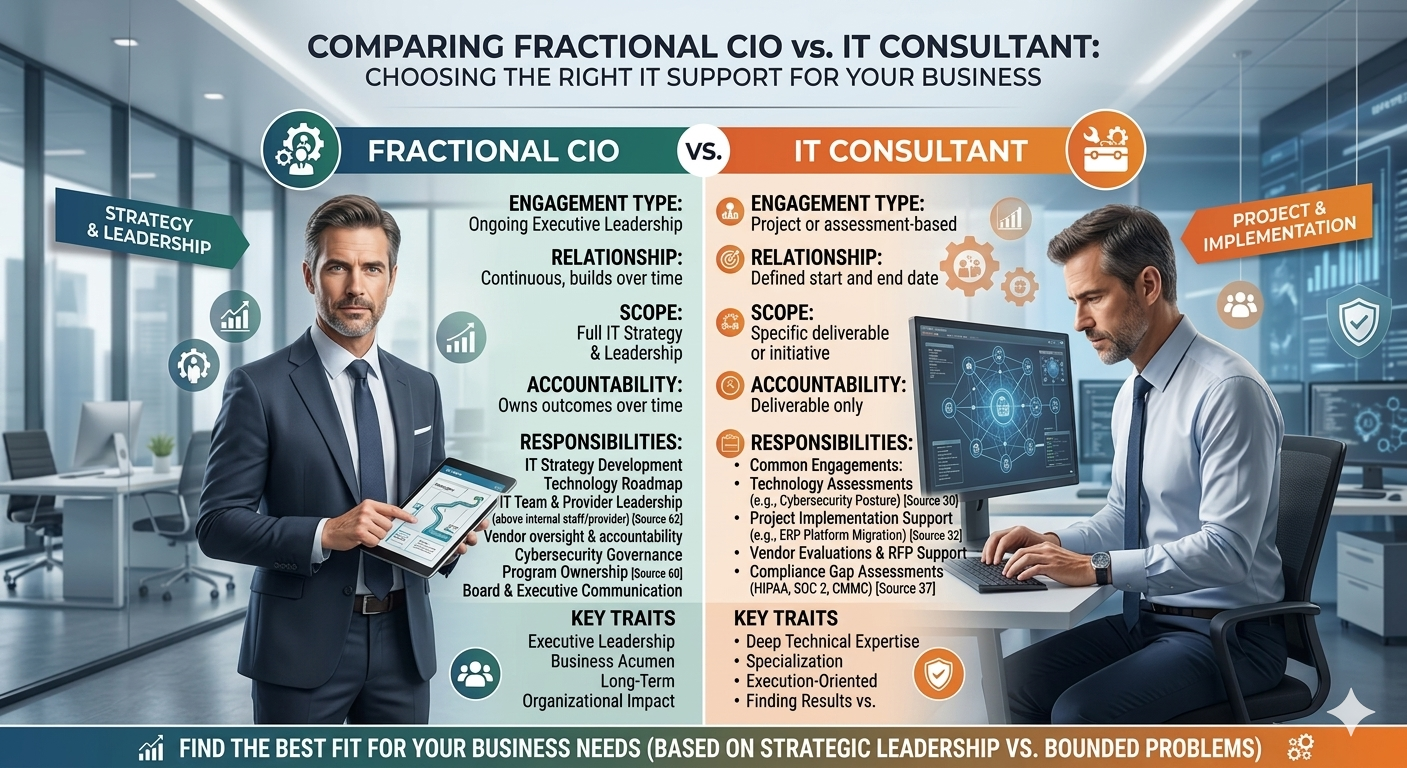
A fractional CIO and an IT consultant are not the same thing, and confusing the two leads to the wrong hire for the wrong problem. A fractional CIO is an ongoing executive leadership role. An IT consultant is typically engaged to solve a specific, bounded problem and exits when the work is done. Both have genuine value, but they serve fundamentally different organizational needs.
If your organization needs strategic IT leadership, vendor accountability, and ongoing technology governance, you need a fractional CIO. If you have a specific problem with a clear scope and a defined end date, an IT consultant may be the right fit. Many organizations eventually need both.
Overview
- A fractional CIO is an ongoing executive leadership role responsible for IT strategy, vendor management, cybersecurity governance, and technology roadmap execution.
- An IT consultant is typically engaged for a specific project or assessment with a defined scope and deliverable.
- The fractional CIO builds organizational knowledge over time and is accountable to long-term outcomes. The consultant delivers a defined output and exits.
- Both roles have legitimate uses, but they address different problems and should not be substituted for each other.
- Many SMBs use IT consultants for specific initiatives while relying on a fractional CIO for ongoing strategic leadership.
What an IT Consultant Actually Does
An IT consultant is brought in to address a specific, defined need. They arrive with expertise in a particular domain, deliver a defined output, and exit when the engagement is complete. The relationship is transactional by design, and that is not a criticism. For the right problem, a transactional engagement is exactly what is needed.
Common IT consultant engagement types
Technology assessments are one of the most common IT consultant engagements. A consultant evaluates a specific area of the technology environment, cybersecurity posture, network architecture, or application landscape, produces a findings report, and provides recommendations. The organization receives a document and the consultant leaves.
Project implementation support is another common use case. A consultant with specific expertise in an ERP platform, a cloud migration framework, or a network infrastructure buildout is brought in to support or lead the technical execution of a defined project. Once the project is complete, the engagement ends.
Vendor evaluations and RFP support are frequently handled by consultants who have deep knowledge of a specific technology category. They help the organization define requirements, evaluate options, and select a solution. They typically do not stay to manage the vendor relationship after selection.
Compliance gap assessments in areas like HIPAA, SOC 2, or CMMC are common consultant engagements for organizations in regulated industries. A consultant evaluates the current state against a specific standard, documents the gaps, and provides a remediation roadmap. Implementation is left to the organization or a separate engagement.
Where IT consultants fall short
The project-based nature of IT consulting is also its primary limitation. A consultant who assesses your cybersecurity posture and delivers a remediation roadmap is not accountable for whether that roadmap gets executed. A consultant who helps you select an ERP platform is not responsible for ensuring the implementation succeeds. A consultant who identifies vendor over-spending is not present to renegotiate the contracts.
The exit is built into the model. That is appropriate for bounded problems but leaves a significant gap when what the organization actually needs is sustained leadership and accountability.
What a Fractional CIO Actually Does
A fractional CIO is an executive leadership role, not a project role. The engagement is ongoing, the relationship deepens over time, and the fractional CIO is accountable to business outcomes rather than deliverable completion.
Strategic IT leadership
The fractional CIO owns the technology strategy for the organization. That includes building and maintaining the technology roadmap, connecting IT investments to business objectives, and ensuring the leadership team has the information they need to make sound technology decisions. This work does not have a project end date. It is continuous and evolves as the business grows.
Vendor oversight and accountability
One of the highest-value functions of a fractional CIO is managing the vendor ecosystem on an ongoing basis. This means holding vendors accountable to contractual commitments, managing renewals, evaluating performance, and ensuring the organization is not paying for services it does not need or use. An IT consultant may help select a vendor. A fractional CIO manages that vendor for the life of the relationship.
Cybersecurity governance
Cybersecurity is not a one-time project. Threats evolve, the organization changes, and the controls that were sufficient twelve months ago may not be sufficient today. A fractional CIO maintains ongoing oversight of the organization’s cybersecurity posture, ensures controls remain current, and responds to emerging risks as they develop. A security consultant produces an assessment. A fractional CIO owns the ongoing program.
IT team and managed provider leadership
If the organization has internal IT staff or a managed IT provider, the fractional CIO provides the executive leadership layer above them. This means setting direction, establishing accountability, and ensuring the team or provider is working toward the right outcomes. An IT consultant does not typically take on this leadership function.
Board and executive communication
A fractional CIO translates technology risk and strategy into business language for the leadership team and board. They prepare technology briefings, report on IT performance, and ensure technology considerations are represented in every major business decision. This is an ongoing executive communication function, not a project deliverable.
The Accountability Gap: Why the Distinction Matters
The most important practical difference between a fractional CIO and an IT consultant is accountability over time. A consultant is accountable for the quality of their deliverable. A fractional CIO is accountable for outcomes.
Consider a common scenario. An IT consultant is engaged to assess the organization’s technology vendor relationships and identify cost savings opportunities. They deliver a thorough report identifying $180,000 in annual savings through contract renegotiation, license consolidation, and vendor elimination. The report sits in a drawer for six months because nobody in the organization has the authority, expertise, or bandwidth to execute the recommendations.
A fractional CIO in the same scenario does not just identify the savings. They own the execution. They renegotiate the contracts, manage the vendor transitions, and ensure the savings are realized. The difference in outcome is not the quality of the analysis. It is the presence of ongoing executive accountability.
Assessments without accountability produce reports. Leadership produces results.
When You Need a Consultant vs. When You Need a Fractional CIO
You need a consultant when you have a specific, bounded problem with a clear scope and a defined end point. The work has a beginning, a middle, and an end, and the deliverable is a document, a decision, or a completed implementation. You do not need ongoing executive leadership to sustain the value of the work.
You need a fractional CIO when you need ongoing executive-level technology leadership that builds organizational knowledge over time, maintains accountability for outcomes, and provides the strategic guidance your leadership team cannot provide internally. The problem does not have an end date because running a technology environment well is a continuous function.
You need both when you have an ongoing need for fractional CIO leadership and a specific initiative that requires specialized expertise beyond what the fractional CIO provides. A fractional CIO who identifies the need for a specialized security assessment and manages the engagement with a security consultant is using both models appropriately.
A Common Mistake: Using Consultants as a Substitute for Leadership
The most expensive mistake SMBs make with IT consulting is using a series of point-in-time assessments as a substitute for ongoing executive leadership. The pattern looks like this: a new risk or challenge emerges, the organization brings in a consultant to assess and recommend, the consultant delivers a report, the report is partially implemented or not at all, the same risk resurfaces six months later, and the cycle repeats.
This approach produces a large library of assessment reports and a technology environment that never materially improves. Each engagement delivers value in isolation but none of them produce lasting organizational change because there is no ongoing leadership to sustain execution.
A fractional CIO breaks this cycle by owning the strategy and the execution on a continuous basis. The consultants brought in under that leadership model serve a specific purpose within a larger framework, rather than being the entire framework.
How ClearStack Advisory Positions These Two Models
At ClearStack Advisory, our fractional CIO engagements are designed to provide the ongoing executive leadership that SMBs across Healthcare, Manufacturing, Professional Services, and Construction need to run their technology environments well. When a specific initiative requires specialized expertise, we identify that need and manage the consultant relationship on behalf of the client.
We have seen what happens when organizations rely exclusively on point-in-time consulting without sustained leadership to implement and maintain the recommendations. We have also seen what happens when a fractional CIO engagement provides the strategic continuity that turns good assessments into lasting improvements.
The difference is not the quality of the advice. It is whether someone with executive authority and organizational commitment is present to ensure the advice gets executed.
Conclusion
A fractional CIO and an IT consultant are complementary tools that serve different purposes. Consultants solve bounded problems with defined deliverables. Fractional CIOs provide the ongoing executive leadership that turns good recommendations into sustained organizational improvement.
For most SMBs, the absence of ongoing IT leadership is the root cause of why technology remains a source of risk and friction rather than a competitive advantage. Point-in-time consulting addresses symptoms. Sustained executive leadership addresses the underlying problem.
Frequently Asked Questions
Can an IT consultant become a fractional CIO for the same organization?
Yes, and it is a natural progression when the consultant has developed trust and organizational knowledge. The shift requires a deliberate change in engagement structure, moving from project-based deliverables to an ongoing retainer with executive leadership responsibilities. Both parties should be clear that the nature of the relationship is changing.
Is a virtual CIO the same as a fractional CIO?
The terms are often used interchangeably, though some use virtual CIO to describe a more advisory or on-call arrangement and fractional CIO to describe a more embedded, defined-hours engagement. In practice, the distinction matters less than the specific scope and accountability structure of the engagement. Always clarify what the role actually includes rather than relying on the title alone.
How do I know if I need a fractional CIO or just a one-time technology assessment?
If your organization has never had executive-level IT leadership, a one-time assessment can be a useful starting point to understand where you stand. However, if the assessment reveals significant gaps, you need ongoing leadership to close them, not another report. Many organizations benefit from starting with an assessment-based engagement that transitions into an ongoing fractional CIO retainer once the scope of the work becomes clear.
Can a fractional CIO manage IT consultants on our behalf?
Yes, and this is one of the most valuable functions of the role. A fractional CIO who understands your technology environment and business goals is well-positioned to identify when a specialized consultant is needed, define the scope of the engagement, evaluate the quality of the deliverable, and manage the implementation of recommendations. This prevents the common problem of consultant reports that never get executed.
What happens after an IT consultant finishes their engagement?
In most cases, the organization receives a deliverable and the relationship ends. Whether the recommendations get implemented depends entirely on whether the organization has the internal capacity and leadership to act on them. Without a fractional CIO or other executive IT leadership in place, consultant recommendations frequently go unimplemented, which means the engagement produces cost without lasting value.
Is it more cost-effective to hire a series of consultants or one fractional CIO?
For ongoing IT leadership needs, a fractional CIO is almost always more cost-effective than a series of consultants. Individual consultant engagements solve individual problems but produce no accumulated organizational knowledge or sustained accountability. A fractional CIO builds that knowledge over time and applies it continuously, which increases the efficiency and impact of every subsequent decision.
Not sure where your IT really stands? Start with a Clarity Audit: a focused assessment of your backups, security, vendors, and AI readiness. It’s the first step in every engagement I take on.
About the author: Chris McGlasson is a fractional CIO and the founder of ClearStack Advisory, where he helps mid-market companies build AI governance, IT strategy, and technology roadmaps without the overhead of a full-time CIO. He previously built and sold LANPRO Systems, an IT services firm serving 350+ enterprise clients.